<?xml version="1.0" encoding="utf-8"?>
<feed xmlns="http://www.w3.org/2005/Atom">
  <title>Eudaemon</title>
  <subtitle>One person finding out whether the data trail of a life can help its owner make properly informed decisions.</subtitle>
  <link href="https://eudaemon.uk/feed.xml" rel="self"/>
  <link href="https://eudaemon.uk/"/>
  <updated>2026-09-14T00:00:00.000Z</updated>
  <id>https://eudaemon.uk/</id>
  <author><name>Matt Finan</name></author>
  <entry>
    <title>03 · The moving target</title>
    <link href="https://eudaemon.uk/log/03-the-moving-target/"/>
    <updated>2026-09-14T00:00:00.000Z</updated>
    <id>https://eudaemon.uk/log/03-the-moving-target/</id>
    <summary>Once the coin has found how much one thing moves another, how long is that number true for? The second test races 2 clocks, how long β takes to pin down against how long it stays put, and the ratio decides whether a question can be answered at all.</summary>
    <content type="html"><![CDATA[<p>Relationships between variables in one’s life form, break and re-form. If Eudaemon finds that a change in one variable causes a change in another, how long does that finding hold true? To recap. Eudaemon turns a person’s records into evidence strong enough to act on, and turns the goals a person brings into questions that evidence can answer. <a href="/log/02-watch-or-try/">Entry 02</a> showed that correlations between variables are limited to generating predictions, and that only causes generate prescriptions; hence the importance of causes, and how they might be uncovered from correlations by experiments where a coin decides. <a href="/log/02-watch-or-try/">Entry 02</a> also introduced ρ, and the impact of that number on whether Eudaemon is more a watcher or an experimenter in the hunt for causes. This entry ties ρ, correlation and causation together to answer that question.</p>
<h2>ρ: how much one night repeats the last</h2>
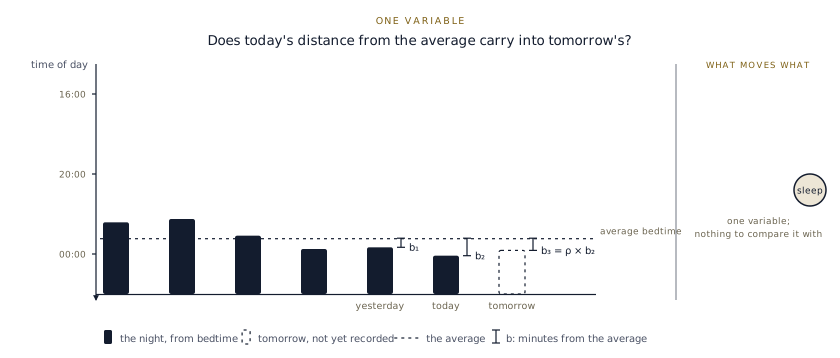
<p><img src="/assets/entry03-one-channel.svg" alt="One variable: time of day running down the page, each night a bar from its bedtime to the foot of the chart, the average bedtime dashed across, yesterday's and today's minutes from it marked b₁ and b₂, and tomorrow dashed at the average plus ρ × b₂, marked b₃; beside it, sleep on its own"></p>
<p>Each night’s bedtime sits some minutes from the average bedtime; call that b. ρ is the extent to which today’s minutes from the average (b₂) persist into tomorrow’s (b₃), taken over every pair of nights in the record. At ρ = 0 the nights vary freely and today tells you nothing about tomorrow beyond the average bedtime itself; at ρ = 1 tomorrow’s minutes are today’s again. For those who prefer an equation:</p>
<p><strong>ρ = Σ(b₂ × b₁) ÷ Σ(b₂ × b₂)</strong><br>
<em>summed over every pair of consecutive nights</em></p>
<p>The best guess for tomorrow’s bedtime, b₃, is then the average plus ρ × b₂, which is the dashed bar on the graph.</p>
<p>If ρ is high, the nights whose variation in bedtime could be attributed to something other than the night before are few, so the number of nights on which an independent cause could show itself is equally small. For high ρ, then, the record takes far longer to identify variables that influence bedtime independently of the night before, and Eudaemon must manufacture that independence with a coin flip experiment. Where ρ is low, Eudaemon can wait and watch.</p>
<h2>r and β: how 2 variables move together</h2>
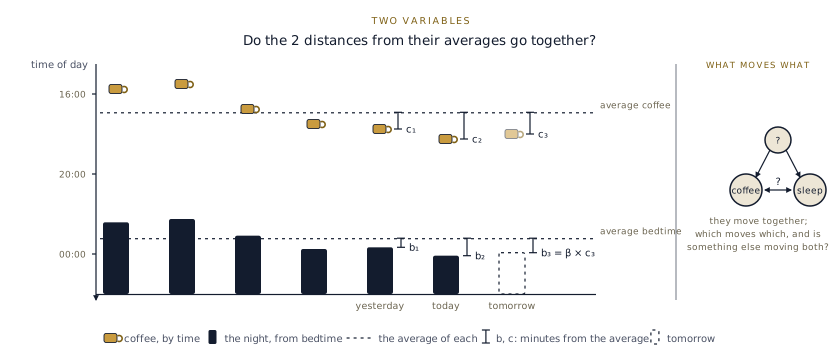
<p><img src="/assets/entry03-two-channels.svg" alt="Two variables on the same time-of-day axis: coffee by the time it was drunk, high in the afternoon with its own average and its minutes from it marked c₁ and c₂, and beneath it each night as a bar from its bedtime, with the average bedtime and b₁ and b₂; tomorrow's coffee planned late, c₃, and tomorrow's bedtime dashed at b₃ = β × c₃; beside it, coffee and sleep joined by a two-way question, with a third thing above pointing at both"></p>
<p>Now add a second variable on the same nights and the same axis: coffee, each cup placed by the time it was drunk, with its own average and its own minutes from it, c. r (correlation) is the extent to which one variable’s distance from its average co-occurs with the other’s, over every night in the record. r runs from 0 to 1 in strength, and on the graph the nights the coffee sits later than its average are the nights the bedtime sits later than its own, so this r would be strong, near 1. However, there’s another number which describes correlations: β.</p>
<p>β is the size of the effect the correlation describes: how many minutes later bedtime falls for each hour later the coffee. So an almost perfect r on a variable that barely moves gives a small β, and a loose r on a variable with a wide spread can give a large one. β is in the units a decision is made in, and it is the number this entry is about.</p>
<p><strong>β = Σ(b × c) ÷ Σ(c × c)</strong><br>
<em>summed over every night</em></p>
<p>A correlation warrants a prediction. If tomorrow’s coffee is planned an hour late, the record predicts a bedtime β minutes later than average; that is the dashed bar, b₃ = β × c₃, and it is the whole of what a watch engine can promise. What it can’t say is what to change, because the record can’t tell which way the link runs, or whether something else moves both.</p>
<h2>The coin: which way the link runs</h2>
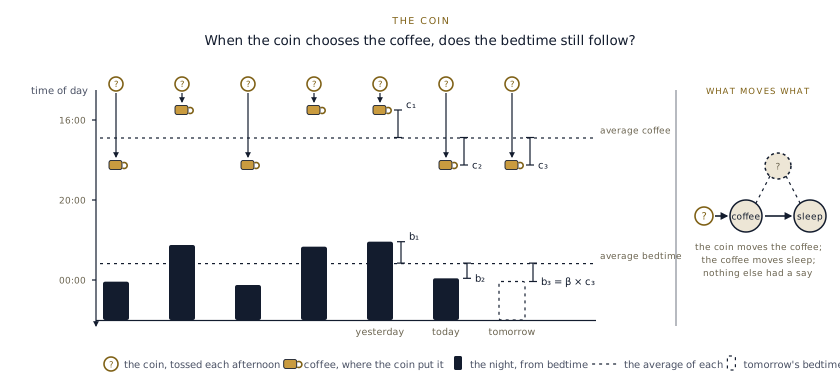
<p><img src="/assets/entry03-the-coin.svg" alt="The coin: a coin above every column with an arrow down to the cup it placed, early or late; the bedtime still running late after the late coffees; tomorrow's coffee already placed, c₃, its bedtime dashed at b₃ = β × c₃; beside the graph, coin → coffee → sleep, with the third thing's links cut"></p>
<p>The purpose of the coin is to force variation in one variable independently of everything else. Each afternoon it dictates whether the coffee is early or late, and nothing else has a say. If the bedtime still runs late after the late coffees, the link runs from coffee to sleep: a poor night can’t have chosen the coffee, because the coin did, and nothing else can have moved both, because the coin consulted nothing. The direction is settled, as the right panel of the diagram shows.</p>
<p>The coin supplies the independence a high ρ withholds, settles the direction of r, and gives the answer in β’s units. Suppose it says late coffee puts bedtime back by 40 minutes, give or take 15, over the 8 weeks it ran. That is the kind of number a decision is made on: what to change to reach a goal, what a big choice would cost, what an agent may do on the user’s behalf. How long does it hold true?</p>
<h2>Two clocks</h2>
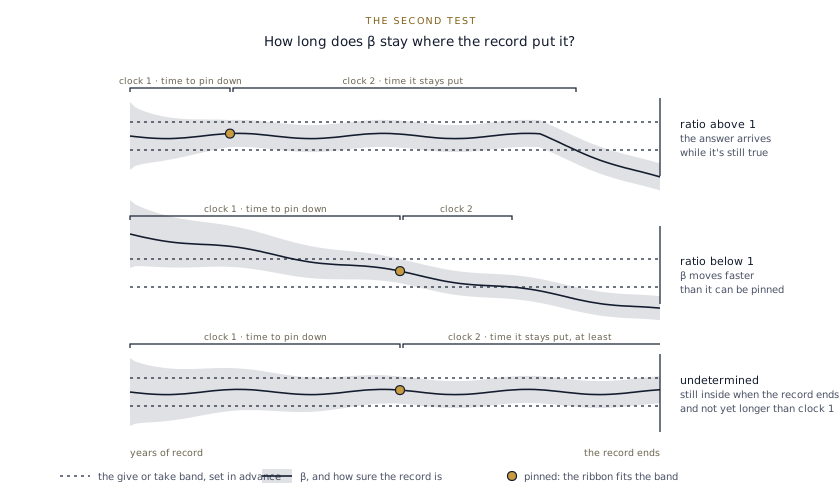
<p>β as calculated doesn’t hold forever. In the coffee example, caffeine tolerance may build, so β shrinks; or a baby arrives and dictates both the bedtime and the coffee, whatever the link between them was. There are 2 clocks: clock 1, how long β takes to calculate; and clock 2, how long it holds true.</p>
<p><img src="/assets/entry03-two-clocks.svg" alt="The second test: β over years of record, with the give or take band set in advance, the ribbon narrowing until it fits, clock 1 bracketed over the pin and clock 2 after it, and 3 outcomes"></p>
<p>The test measures clock 2 by watching the archive: calculate β on one stretch of the record, with its give or take as a band around it. Measure β again on later stretches and record whether it remains within the band or has moved outside it. Where it has moved, the time it stayed put before moving is clock 2.</p>
<h2>Importance to Eudaemon</h2>
<p>Dividing clock 2 by clock 1 gives a ratio, and the test is how those ratios fall across every β the record can pin. Above 1, the answer arrives while it’s still true; the bigger the ratio, the longer β stays useful. Below 1, β has moved before it was known, and is of no use. A β still inside its band when the record ends has stayed put for at least that long, and where that isn’t yet longer than clock 1 the ratio is undetermined. β describes a relationship between 2 variables, and life has thousands of variables, so hundreds of thousands of βs. The more of those ratios sit above 1, the more useful Eudaemon is to that user: the record can establish things about them that stay true long enough to act on, and the build order stands. Mostly below 1, and the project contracts to the questions that settle quickly, plus a small annex of experiments.</p>
<hr>
<p><strong>This week’s files.</strong> The 4 figures in this entry, in light and dark · the QA run record.</p>
<p><strong>Next.</strong> The next test on the list.</p>
]]></content>
  </entry>
  <entry>
    <title>02 · Watch or try</title>
    <link href="https://eudaemon.uk/log/02-watch-or-try/"/>
    <updated>2026-08-30T00:00:00.000Z</updated>
    <id>https://eudaemon.uk/log/02-watch-or-try/</id>
    <summary>Why Eudaemon needs causes rather than patterns, and the one number, measured before anything is built, that decides whether it becomes a reader of one&#39;s records or an engine for small experiments.</summary>
    <content type="html"><![CDATA[<p>To recap. Eudaemon turns a person’s records into evidence strong enough to act on, and turns the goals that person brings into questions that evidence can answer. <a href="/log/00-the-premise/">Entry 00</a> described this premise and the 70+ data streams I’d obtained from my life; <a href="/log/01-the-blueprint/">entry 01</a> turned the design into a list of assumptions that could be tested before anything gets built. Those assumptions are now tests, ranked by how far each result could change what I do. This entry concerns the first such test.</p>
<h2>What a record can show</h2>
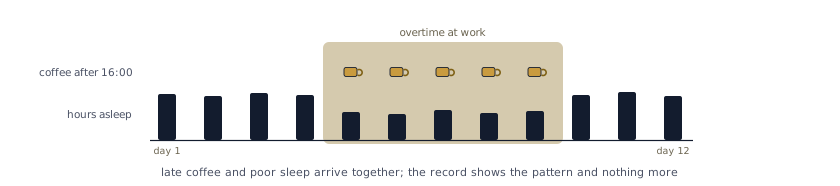
<p>Every question I want this system to answer has the same shape: if I change X, what happens to Y? Would skipping the afternoon coffee lead to better sleep? Does a late Thursday meeting kill the whole evening? Take the coffee question, and take an invented fortnight of records to ask it of: is it the coffee or the overtime that ruins sleep?</p>
<p><img src="/assets/entry02-record.svg" alt="Twelve example days: coffee cups on exactly the overtime days, and shorter hours-asleep bars on those days"></p>
<p>Late coffee and poor sleep arrive together, on exactly the days of overtime. That co-arrival is a correlation. It’s useful: given this afternoon’s coffee, the record predicts a poor night, and it will often be right. What it can’t say is whether dropping the coffee would change anything. A pattern licenses a prediction; only a cause licenses a change.</p>
<h2>Two worlds write that record</h2>
<p><img src="/assets/entry02-two-worlds.svg" alt="World A, where coffee causes poor sleep, and World B, where overtime drives both"></p>
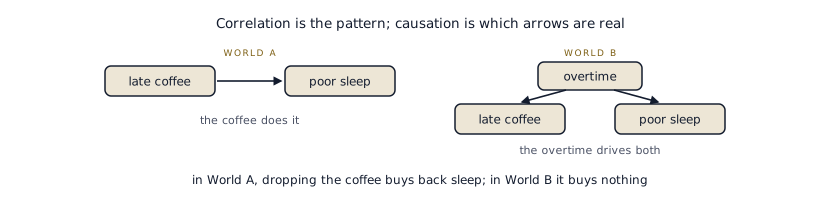
<p>In World A the coffee delays sleep. In World B the overtime drives both the late coffee and the poor sleep, and the coffee does nothing. It was only ever along for the ride. Both worlds produce exactly that fortnight. The advice they license is opposite. In World A, dropping the coffee buys back sleep; in World B dropping the coffee buys back nothing (though it does save on washing up). 5 more years of the same record would sharpen the pattern without ever saying which world wrote it.</p>
<h2>So how do we decide?</h2>
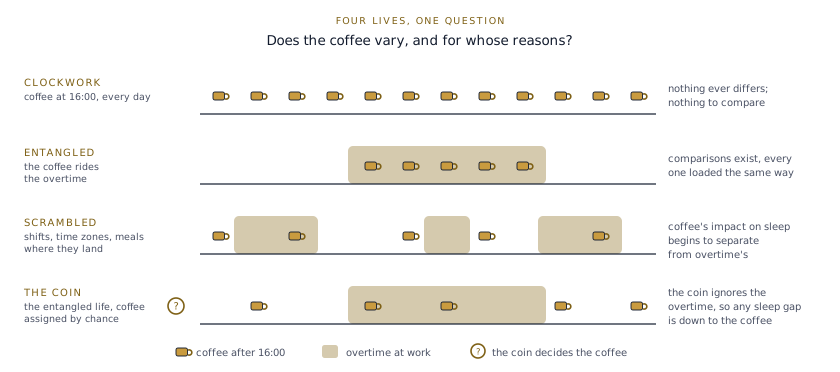
<p>Randomised variation. The reasons for drinking the coffee must be entirely independent of every other reason for sleeping badly; otherwise no comparison of coffee days against the rest can prove whether the coffee is the culprit.</p>
<p><img src="/assets/entry02-four-lives.svg" alt="Four lives: clockwork, entangled, scrambled, and the coin"></p>
<p><em>One question in each life: what would comparing coffee days against the rest establish?</em></p>
<p>In the clockwork life the coffee never varies, so there’s nothing to compare. No record, however long, learns the effect of a thing that never changes. In the entangled life the coffee arrives only with the overtime, so every comparison is loaded, and more years measure the same loaded comparison more precisely. In the scrambled life the coffee varies for dozens of unconnected reasons: shift patterns, time zones, meals grabbed where they land. The reasons for the coffee come apart from the reasons for the poor sleep, and each context knocks out a different rival explanation. A link that survives night shifts, holidays and ordinary weeks alike starts to earn the word cause. A life like that runs experiments on itself by accident. The coin doesn’t copy the chaos; it manufactures the one ingredient that matters. Toss it each afternoon and the chance of coffee is the same on good days and bad; the coffee is forced to vary independently of everything else. Compare the coffee days against the rest. Whatever difference survives, beyond chance, is the coffee.</p>
<h2>The number that decides the design</h2>
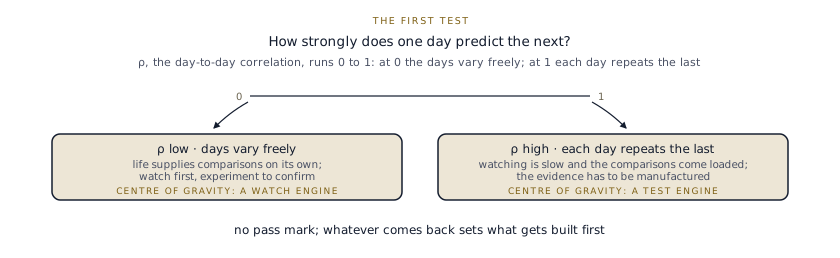
<p>The first test measures which of those lives each channel of a record (sleep, spending, heart rate) is living. The measure is ρ (spoken “rho”), the day-to-day correlation, running from 0 to 1: at 0 the days vary freely (the scrambled life), at 1 each day repeats the one before (the clockwork or the entangled life). The more freely the days vary, the more comparisons life supplies on its own, and the more Eudaemon can learn by watching. The more the days repeat, the more time has to pass before causation can be assessed by watching. Repetition starves the arithmetic. Bayley and Hammersley’s 1946 formula, the standard effective sample size result for an autocorrelated series, converts ρ into the number of independent days a run of correlated ones is worth: n(1 - ρ)/(1 + ρ). At 0.8 it says a year of one channel carries about as much information as 41 independent days.</p>
<p>So the test computes ρ across every source in the archive: one number per channel, not one per life, because a sleep pattern and a spending pattern have no reason to repeat at the same rate.</p>
<p><img src="/assets/entry02-rho-fork.svg" alt="The rho scale, and the fork it sets between a watch engine and a test engine"></p>
<p>There’s no pass mark, and this test can’t fail. Whatever comes back sets the centre of gravity of what gets built first. Low, and Eudaemon leans watch engine, a careful reader of the records already held, with experiments kept for confirmation. High, and reading harder is a dead end; the effort goes into the machinery that makes tomorrow deliberately unlike today, and Eudaemon leans test engine.</p>
<hr>
<p><strong>This week’s files.</strong> The ranked test register · the 4 figures in this entry, in light and dark · the QA run record.</p>
<p><strong>Next.</strong> The next test on the list.</p>
]]></content>
  </entry>
  <entry>
    <title>01 · The blueprint</title>
    <link href="https://eudaemon.uk/log/01-the-blueprint/"/>
    <updated>2026-08-02T00:00:00.000Z</updated>
    <id>https://eudaemon.uk/log/01-the-blueprint/</id>
    <summary>No code yet, on purpose. The idea was broken into parts, attacked by 8 independent AI reviewers and rebuilt into a blueprint worth testing.</summary>
    <content type="html"><![CDATA[<p>To recap last week’s blog post; 00: everything you do leaves a record, from bank statements to sleep, and I’m in the process of claiming mine, about 70 sources so far. The system I’m building is called Eudaemon: how good a decision is correlates with the volume of data brought to bear when it’s made, and Eudaemon asks what happens if an entire lifetime’s records are brought to bear on every decision; would life be more fulfilled? I also promised to break the idea into testable pieces before building any of it.</p>
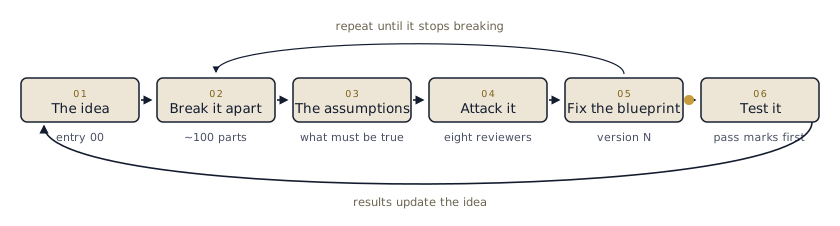
<p>This week was that promise. You wouldn’t build a bridge without first testing the materials and checking the load on every beam; software deserves the same discipline. A couple of hours of reading confirmed the instinct is exactly how the serious end of engineering works; it’s the method NASA uses to design missions. Break the system into parts. Write down what each part assumes to be true. Attack the assumptions that could kill the project before you build anything.</p>
<p><img src="/assets/entry01-loop.svg" alt="The working method: the idea is broken apart, its assumptions listed, attacked by reviewers, the blueprint fixed, then tested"></p>
<p><em>The whole method is one loop. The gold dot is where this entry stands.</em></p>
<p>What actually happened, in order:</p>
<ul>
<li>I broke Eudaemon into its parts: 8 big blocks (the lakes, the deep twin, Telos and the machinery around them), and roughly 100 parts in total across them.</li>
<li>For every part, what it assumes to be true was written down as a plain sentence that can be proved wrong. 138 sentences.</li>
<li>Together, the blocks, the parts and their assumptions make up <a href="/blueprint/">the blueprint</a>: the full written plan for the system, one document, versioned like software (v0.3, 02.08.2026).</li>
<li>The blueprint went to 8 independent AI systems from different companies, each told to attack it: find what’s missing, and for every fault describe exactly how it would fail in real life. None saw another’s answers. About 230 findings came back.</li>
<li>The blueprint was fixed: 28 missing parts added, most of them the dull machinery of backups, monitoring and repair that real systems die without; the weakest ideas rewritten; and a short list drawn up of what must be designed on paper before any code.</li>
</ul>
<p>The most important thing the reviewers found: a system that watches you and advises you also changes you, the way weighing yourself every morning changes what you eat. Eudaemon will be advising me using data about a person its own advice is reshaping. Get that wrong and the failure is quiet: 6 of the 8 reviewers, working separately, described the same slow ending, a machine that carries on politely, every dial reading normal, while it describes a person I stopped being years ago. So that’s now designed in. The system treats itself as part of my life rather than a camera outside it, measures its own influence, and has to earn the right to sound confident rather than assume it.</p>
<p>Where that leaves the idea. Entry 00 promised 19 testable pieces; after this week there are 39. The extra 20 aren’t new ambitions, they’re places the reviewers showed my thinking was too coarse. That’s the point of doing this before building: every one of those weaknesses was going to be found eventually, and finding one in a review costs a morning, where finding it in a finished product costs a rebuild.</p>
<p>So the week’s output is the blueprint, version 3, where every part can be traced back to the review that shaped it, and an honest list of what still has to be proved. The 39 testable pieces get <a href="/blueprint/">their own page</a>, because a promise you can’t read is a promise that can’t fail.</p>
<aside class="revised"><span class="rev-label"><span class="dot"></span>Revised 31.08.2026</span>
<p>39 became 52 after a second review round, and 62 once the consolidated design turned every remaining assumption into a ranked test. The blueprint still shows the 52 of v0.5 until it is rewritten.</p>
</aside>
<p>Coming next. Entry 02: the tests. Each one gets its pass mark and its fail mark written down before it runs, so I can’t move the goalposts afterwards.</p>
<hr>
<p><strong>This week’s files.</strong> Blueprint v0.3 · 8 review sets, kept word for word · the 39 testable pieces · the 138 engineering assumptions.</p>
<p><strong>Changed my mind.</strong> Eudaemon isn’t a camera pointed at my life; it’s part of the life it measures, and has to be designed that way.</p>
<p><strong>Next.</strong> Entry 02: the tests, pass and fail marks first.</p>
]]></content>
  </entry>
  <entry>
    <title>00 · The premise</title>
    <link href="https://eudaemon.uk/log/00-the-premise/"/>
    <updated>2026-07-25T00:00:00.000Z</updated>
    <id>https://eudaemon.uk/log/00-the-premise/</id>
    <summary>What I&#39;m building, why now, and the question everything else depends on.</summary>
    <content type="html"><![CDATA[<p>Everything you do leaves a record. Your bank knows what you value; your smartwatch knows how you slept; your inbox knows who you owe a reply and nearly all of it is retrievable.</p>
<p>The question this project exists to answer; what happens if one claims the lot, and translates it into something a computer could understand? Could a machine approximately fathom a person in any meaningful sense? Could it review one’s aspirations vs. one’s past, could it demonstrate what reaching them would actually take, break that into actions sized for a Tuesday, and gradually become an agent that does the schlep itself?</p>
<h2>The claim</h2>
<p><strong>“There is a correlation between the volume of data used to make a decision and the quality of that decision.”</strong> The project is built on this assumption. It’s not new; aviation runs on it, so does every supermarket. Entry 01 breaks it into 19 testable hypotheses. What’s new is that a single person can now hold all of their own evidence; UK data protection law enables personal data aggregation, we carry supercomputers in our pockets and medical-grade data collection devices on our wrists; and modern AI democratised analysis that once required a research department, within reach of one determined amateur. The price of entry has fallen to the cost of an internet connection, an eBay account and some stubborn emails.</p>
<p>I sent the emails. My bank, my doctor, my old university, my supermarket, my phone provider, the government, the chess site I lose on; about 70 sources so far. The results collected into data lakes: an encrypted hard drive of 242 gigabytes of bank transactions, heart rate and sleep, location history, receipts, emails, medical records and transcribed notebooks and sketches.</p>
<h2>The machine</h2>
<p>The project is called Eudaemon (from the Greek; “eu” = “good”, “daemon” = “spirit”/a term in computing for a process that works quietly in the background). The system has 4 layers. One of them exists today; the lakes are real and filling. The other 3 are the proposal under test.</p>
<p><strong>The lakes.</strong> Every record about me I can lawfully obtain, plumbed to keep automatically topped up.</p>
<p><strong>The deep twin.</strong> Analysis over the lakes; a working model of me. Not a chatbot doing an impression of me. A model of what I actually do, when, under what conditions.</p>
<p><strong>Telos.</strong> (Greek again; the end a thing aims at.) I bring a goal; the twin sharpens it, works out what reaching it would take for me specifically, recursively turning each <em>what</em> into a <em>how</em>. Its intention is not to rule things out, but to elucidate the cost of one’s aspirations in time, energy, resource and what one would have to change. This allows informed decision making.</p>
<p><strong>Jarvis.</strong> Named after Tony Stark’s assistant, and doing the same job. An agent layer that executes what the layers above specify for it. On its own it would be a generic assistant; armed with the deep twin’s model, it can act as I would act, minus the human limits: it doesn’t sleep, it doesn’t forget.</p>
<p><strong>The twin never tells me what to want.</strong> I bring the goal; its job is to sense-check it. If I say “I want to be rich”, its first response is questions: how much, by when, cash or assets? It might conclude: “I can’t find a method that reliably gets you £100 million in 30 years, because your record shows you don’t stick to plans; here’s what would have to change, and here’s what that change looks like as things you could actually do.” Not “no”. Not “you lack discipline”. A price, in performable terms. Whether I pay it stays my decision.</p>
<p>Why bother? Because the prize is time; the weekly hours that go on admin/logistics and energy; the less friction and intrusion into your bandwidth. Win both back and you’re left to lead life more fulfilled with that which you value; the family, the garden, the work that matters, whatever it is that makes your life worth living.</p>
<h2>What this site is</h2>
<p>The internet does not lack announcements of personal AI. What it lacks is follow-through in public: claims stated so they can fail, tests published with the abandon conditions declared in advance, and the author’s changes of mind dated and kept on the record rather than tidied away. That’s the offer here. If the idea dies, this site becomes the record of a proper autopsy.</p>
<p>It’s also, first, an archive for me. I’ll write roughly weekly: what I did, what I didn’t and what I believed at the time. The vision I have now likely won’t survive unchanged, and I’d rather keep a dated record of the mind changing than a tidied-up story written afterwards.</p>
<p>Coming next. Entry 01: how I broke the idea into 19 testable hypotheses. Entry 02: the tests, and the failure criteria written before running them.</p>
<aside class="revised"><span class="rev-label"><span class="dot"></span>Revised 02.08.2026</span>
<p>19 became 39: the blueprint review showed where the thinking was too coarse. The story is <a href="/log/01-the-blueprint/">entry 01</a>.</p>
</aside>
<aside class="revised"><span class="rev-label"><span class="dot"></span>Revised 31.08.2026</span>
<p>39 became 62: every assumption in the consolidated design is now a ranked test, ordered by how much its result could change what I do.</p>
</aside>
<p>I don’t know if Eudaemon works. Deep twin might predict me no better than a coin toss. Finding out costs a few weekends, let’s see what happens.</p>
]]></content>
  </entry>
</feed>